
Source: Peta
Showing posts with label Kentucky Fried Chicken. Show all posts
Showing posts with label Kentucky Fried Chicken. Show all posts
2008-12-04

2008-11-25
2007 Tyson Slaughterhouse

Tyson Workers Caught Torturing Birds, Urinating on Slaughter Line
Footage taken at Tyson Foods slaughterhouses in Georgia and Tennessee. Narrated by the investigator, whose voice has been altered to protect his identity.
Have you ever wondered about the ingredients in the Colonel's secret recipe chicken? If the flesh came from Tyson Foods, a major KFC supplier, there's a chance the big secret is that the bird was coated in human waste before reaching the dinner plate.
PETA conducted an undercover investigation in 2004/2005 at a Heflin, Alabama, Tyson slaughterhouse, but even that did not prepare us for the disgusting acts that would be documented during two 2007 investigations. On nine separate days, PETA's investigator saw workers urinating in the live-hang area, including on the conveyor belt that moves birds to slaughter.
The investigator also documented sickening cruelty to animals in both the Georgia and Tennessee slaughterhouses. Supervisors at both facilities either were directly involved in the abuse or were made aware of it by the investigator—but they did not stop it. In addition to the cuts and broken limbs suffered by live chickens at nearly every slaughterhouse, the investigator documented the following:
- One worker admitted that he broke a chicken's back by beating the bird against a rail, a back-up killer stabbed birds in the neck area with knives, and several birds were hung from shackles by their necks instead of by their legs.
- PETA's investigator caught on videotape a supervisor telling him that it was acceptable to rip the heads off live birds who had been improperly shackled by the head.
- Workers—sometimes standing 4 to 6 feet away from the conveyor belt—violently threw birds at the shackles. Some animals slammed into the shackles and fell onto birds on the conveyor belt below, at which point the worker sometimes repeated the abuse.
- Birds died when their heads and legs became trapped under a door at the end of the conveyor belt that transported live birds to be hung. A supervisor was aware of this problem but did nothing to stop it.
- The killing-machine blade often cut birds' bodies instead of their throats. Although aware of this problem, a supervisor offered no solution, instead blaming the problem on the "nature of the machine."
PETA has written to Tyson Foods and asked the company to fire all the workers who were responsible for the abuse documented in these two facilities, immediately install video cameras on all killing floors and in all hang areas, and hire its own undercover investigators to look for and report cruelty. Peta is also calling on Tyson and KFC to phase in a far less cruel method of slaughter known as controlled-atmosphere killing, which would eliminate worker contact with live animals.
From December 2004 through February 2005, a PETA undercover investigator worked on the slaughter line of a Tyson Foods chicken processing plant in Heflin, Alabama. Using a hidden camera, he documented the treatment of the more than 100,000 chickens killed every day in the plant.
What the investigator saw was truly horrifying. Birds were frequently mutilated by throat-cutting machines that didn't work properly; one bird had her skin torn entirely off her chest. Workers were instructed to rip the heads off birds who had missed the throat-cutting machines, and our investigator was told not to stop the line for missed birds. Plant employees were seen throwing dying birds around just for fun.

PETA's investigator also witnessed numerous birds who were scalded alive in the feather-removal tank while they were still conscious and able to feel pain. Plant managers told him that it was acceptable for 40 animals per shift to be scalded alive, and no one was reprimanded when far more than 40 birds suffered this fate during any given shift
PETA's investigator repeatedly expressed concern to plant supervisors about the treatment of the chickens, but his complaints were ignored.
Animal-welfare experts agree that this sort of treatment is unacceptable. Dr. Temple Grandin of Colorado State University wrote, "This is a total FAILURE on animal welfare," and Dr. Mohan Raj of the University of Bristol wrote that "due to the lack of appropriate legislation to protect the welfare of birds at slaughter people seem to get away with [these] cruel and unethical practices." Indeed, chickens are not afforded any protection under any federal animal welfare legislation. The Humane Methods of Slaughter Act leaves chickens and turkeys out entirely. Read statements from these and other animal welfare experts.
As hard as it is to stomach, this sort of treatment is entirely too common in modern chicken slaughterhouses. Previous undercover investigations have turned up injured and dying birds left unattended during workers' lunch breaks and workers who ripped animals limb from limb, threw live chickens against walls, and stomped up and down on them on the ground.
Sadly, all these abuses were entirely preventable. In 2003, PETA first contacted Tyson about a new chicken slaughter technology known as controlled-atmosphere killing (CAK), a process that replaces oxygen in the air with an inert gas such as nitrogen—which already makes up 78 percent of the air we breathe—masking the lack of oxygen and putting the birds to sleep quickly and painlessly. CAK would have eliminated all the cruelty that took place in all these investigations, from mutilation by the cutting machine to live scalding, because the birds would have been killed much earlier in the slaughter process and would not have been handled by the workers until they were dead.
Tyson Investigation Photo Gallery
A worker rips the head off a live chicken.

A decapitated chicken stands among the heads of other chickens decapitated by Tyson.

Birds in this Tyson plant are routinely mutilated when the "kill knife" misses their necks and instead slices open their thighs, faces, chest cavities, and more.


The best thing that you can do to help spare animals from such torture is to stop eating them and, thus, stop supporting the industry that allows such cruelty to occur.
What the Investigator Saw
Eyewitness Testimony From PETA's Investigation Into a Tyson Foods, Inc., Chicken Slaughterhouse
PETA's investigator witnessed and documented cruel killing methods being used at a Tyson Foods chicken slaughterhouse in Heflin, Alabama. The slaughtering system being used at the plant resulted in the torture of countless chickens—the routine mutilation by a mechanical blade, manual decapitation, and scalding in defeathering tanks—all while they were still completely conscious. The following are excerpts from the investigator's notes:
December 7, 2004: First day at Tyson. I see the "live hang room" on the new employee tour. The air is hot and thick with the stench of blood. The only illumination is from dim red lights, like a photographer's dark room. This is supposed to keep chickens calm, but they are frightened; squawking, running, flapping their wings, and trying to hide. Workers move at a furious pace to hang live chickens by their feet from metal shackles on a conveyor belt. Birds' throats are cut by automatic blades further down the line. A worker cuts the throats of chickens the machine misses. The noise of voices, machines, and chickens screaming is deafening.
I'm told Tyson kills 150 to 200 thousand chickens a day here and that I'll "get used to" the noise and smells.
December 8, 2004: First day as "backup killer." I have to cut chickens' throats the automated blade misses, so they don't go into the scalding feather-removal bath alive. Only one person does this job, and the line moves so fast, it is impossible to give every chicken a lethal cut. When more chickens come through than can be handled, some workers rip off their heads while they hang shackled. They ignore the squawking and blood; that's business as usual on the killing line. There is a help button and an emergency stop button, but my boss tells me not to stop the line for missed birds. If no one comes to help immediately, birds are scalded to death.

December 9, 2004: A worker picked up one chicken who escaped the shackles and smashed her against the side of a wheelbarrow full of dead chickens. He left her convulsing on top of the corpses.
December 12, 2004: Took footage … of birds in a wheelbarrow who were alive/injured on top of other birds who were dead. Birds in the wheelbarrow get dumped into a Dumpster outside.
December 13, 2004: Took more video of birds in a pile of dirt and fecal matter on the floor. Some were alive, some were dead ... I noticed today that many birds coming to me had their wings broken and bones exposed. It was almost always the birds' left wing … I noticed many birds with broken wings—and one who had been mutilated by the blade seemed to have her chest ripped open somehow.
December 14, 2004: The beginning of today's video shows more of my coworkers ripping birds' heads off. It is lengthy. After this, I have a conversation with my boss. I tell him that many birds come through with broken wings and ask why. He confirms my suspicion that it is because of a malfunction in the machinery that cuts the birds' throats. Then I ask him if this is also why some birds come through mangled, with their chests cut, and he nods yes … . This results in live birds with broken wings and other mutilations.
December 15, 2004: During work, I saw a bird whose head had been painfully hung in the shackles underneath his foot.
December 16, 2004: Today, I was assigned the job of putting dead birds into wheelbarrows and taking them out to the Dumpster … . At one point, I picked up a baby bird and placed her on the conveyor belt. The guy working that part of the line picked up the bird and slammed her into the belt—to kill her, I assume.
December 19, 2004: Many mutilated chickens were coming down the line. One bird's chest was slashed open. Some were split in half, while some were completely gone—the only thing left was their legs hanging from the shackles. I ran down the line trying to cut all their throats and saw that the cutting machine had malfunctioned. I stopped the line and called for help. I had to cut each waiting chicken's throat by hand while maintenance workers fixed it.
February 7, 2005: [L]ast night, I witnessed a bird who was obviously hung in a hurry—as she was only hanging by her head in the leg shackle. I stopped the line, removed her, and started the line again. She blinked numerous times and she was breathing as I laid her down. I am guessing her neck was broken and she was paralyzed. For whatever reason, she was unable to move.
What the Experts Say
Comments on PETA's Investigation Into Tyson's Chicken Slaughterhouse
Academic and professional experts in poultry welfare, veterinary medicine, and humane slaughter reviewed PETA's video footage from an investigation into Tyson Foods' chicken slaughterhouse in Heflin, Alabama. Below are some excerpts from these experts' statements:
Dr. Temple Grandin, Ph.D.
Associate Professor, Department of Animal Sciences, Colorado State University
Dr. Grandin is internationally regarded as one of the leading experts and industry consultants on farmed-animal slaughter, handling, and welfare. She has designed equipment and systems that are used in facilities across the country, and she serves on the animal-welfare panels of several leading corporations.
- "If I had been doing a welfare audit, this plant would have FAILED."
- "Live birds were observed entering the scalder. This is a total FAILURE on animal welfare. Allowing 40 birds per day to enter the scalder alive is not acceptable. This is a sloppy operation."
Dr. A.B.M. Raj, B.V.Sc., M.V.Sc., Ph.D.
School of Clinical Veterinary Science, Division of Farm Animal Science, University of Bristol
Dr. Raj has published more than 50 scientific papers on various methods of stunning and slaughter and served as a member of the working group on stunning and slaughter for the European Union Scientific Veterinary Committee on Animal Health and Animal Welfare. He is currently a member of working groups on stunning and slaughter for the European Food Safety Authority and the World Organisation for Animal Health.
- "Mutilation of live poultry by the killer is totally unacceptable on bird welfare grounds. The reality is that the killer not only mutilated the bird but also failed to cut the major blood vessels supplying oxygenated blood to the brain requiring cervical dislocation. . . . Cervical (neck) dislocation is extremely painful and distressing."
- "Evidently, due to the lack of appropriate [legislation] to protect the welfare of birds at slaughter, people seem to get away with [these] cruel and unethical practices."
Dr. Laurie Siperstein-Cook, D.V.M.
Avian Veterinarian, School of Veterinary Medicine, University of California at Davis
Dr. Siperstein-Cook has a veterinary practice specializing in birds, including chickens, and has testified before the California legislature on poultry welfare issues.
- "Many of these birds were likely conscious when they were lacerated, having missed the stun bath and contorting their bodies trying to escape. They would then have felt the pain of the laceration and would have suffered for many minutes until being killed later in the process."
- "Another section shows those birds who were missed by the stun bath, the mechanical blade, and the backup killer. These conscious birds then enter the scalding bath to experience the pain, suffering and fear of being burned over their entire bodies while held under water. One of these birds is vocalizing beforehand, clearly demonstrating that he/she is fully conscious."
- "This video demonstrates egregious failings on the part of the design, staffing and training at this slaughterhouse. NO birds should be allowed to miss any of the steps that would ensure PROPER stunning to unconsciousness before being cut or caused any painful step in the slaughter process. This means rapid and complete loss of consciousness. This video clearly demonstrates lapses in this facility and the resulting inhumane treatment of these animals."
Dr. Brenda Forsythe, M.S., Ph.D., D.V.M.
School of Veterinary Medicine, University of California at Davis
Dr. Forsythe has a private veterinary practice, holds both master's and doctoral degrees in animal science from California Polytechnic State University and Auburn University and recently accepted an appointment as co-chair of the Animal Welfare Task Force for the California Veterinary Medical Association.
- "[T]here have been numerous violations of generally accepted humane standards at this slaughtering plant. The methods as employed result in unnecessary pain and suffering."
- "By far the most potentially painful problem with this plant was … conscious birds scalded to death in the defeathering tank. These animals that somehow avoided being properly stunned in the stun bath as well as a rapid and humane death on the line are subjected to a slow and excruciating death by scalding in the defeathering tank. This is inexcusable in a well-run slaughter plant and simply should not happen."
Dr. Christine Nicol, M.A., Ph.D.
Professor of Animal Welfare, School of Clinical Veterinary Science, Division of Farm Animal Science, University of Bristol
Professor Nicol is one of the leading poultry welfare experts in the world and has published dozens of articles on the subject.
- "[T]he footage suggests that basic regulatory mechanisms to ensure a swift and pain-free death are not being implemented at this slaughterhouse."
- "Even if only a relatively small proportion of birds are injured by poorly managed or calibrated equipment, this will result in the suffering of a very large number of individual animals."
Source: Peta
2008-11-23
Kentucky Fried Cruelty
KFC suppliers cram birds into huge waste-filled factories, breed and drug them to grow so large that they can’t even walk, and often break their wings and legs. At slaughter, the birds’ throats are slit and they are dropped into tanks of scalding-hot water—often while they are still conscious. It would be illegal for KFC to abuse dogs, cats, pigs, or cows in these ways.
KFC’s own animal welfare advisors have asked the company to take steps to eliminate these abuses, but KFC refuses to do so. Many advisors have now resigned in frustration.
Please join Pamela Anderson, Sir Paul McCartney, His Holiness the Dalai Lama, The Rev. Al Sharpton, and countless other kind people worldwide by not eating at KFC.
Why KFC?
- The roughly 1 billion chickens killed each year for KFC's buckets are crammed by the tens of thousands into excrement-filled sheds that stink of ammonia fumes.
- The birds’ legs and wings often break because they’re bred to be too top-heavy and because workers carelessly shove them into transport crates and shackles.
- Chickens’ throats are slit and the animals are dropped into tanks of scalding-hot water to remove their feathers, often while they are still conscious and able to feel pain.
- KFC lets frustrated factory-farm and slaughterhouse workers handle live birds, so many of the animals end up being sadistically abused. At a KFC “Supplier of the Year” slaughterhouse in West Virginia, workers were documented tearing the heads off live birds, spitting tobacco into their eyes, spray-painting their faces, and violently stomping on them. This was discovered more than two years after KFC promised PETA that it was taking animal welfare seriously.
- KFC hides behind its Animal Welfare Advisory Council, even though five members of the council have resigned in frustration. One of them, Adele Douglass, told the Chicago Tribune that KFC “never had any meetings. They never asked any advice, and then they touted to the press that they had this animal-welfare advisory committee. I felt like I was being used.”
How KFC Can Clean Up Its Act
PETA wants KFC to adopt the animal welfare program developed by five members of its own animal welfare board. These advisors are the world’s top poultry experts; they advise the meat industry in North America and Europe and believe that KFC can—and should—adopt them. KFC has yet to do any of the following:
- Adopt the “Animal Care Standards” program. This would lower the amount of ammonia in the air in factory farms, improve the living spaces and lighting in chicken sheds, prohibit the intentional starving of breeding birds, and ensure that birds are provided with mental and physical stimulation.
- Switch to controlled-atmosphere killing (CAK). This would prevent live birds in slaughterhouses from being abused by workers, having their throats slit, or being scalded while they were still conscious. CAK would also improve conditions for workers and decrease contamination levels in chickens’ flesh.
- Switch to mechanized chicken gathering. This would drastically reduce the number of broken bones and painful bruising that birds endure when factory-farm workers carelessly throw them into transport crates.
- Breed for health rather than rapid growth, and stop feeding drugs to chickens. This would reduce the rate at which birds suffer painful, crippling diseases and injuries, such as broken legs, heart attacks, and lung failures.
- Make all welfare standards transparent and verifiable. This would simply ensure that the animal welfare program is being adhered to through announced and unannounced independent audits (the results of which must be made available to the public through KFC’s Web site).
Undercover investigation
“[KFC] never had any meetings. They never asked any advice, and then they touted to the press that they had this animal-welfare advisory committee. I felt like I was being used.”
—Dr. Adele Douglass, former animal welfare advisor to KFC, Chicago Tribune
Every time undercover investigators enter the facilities of KFC’s suppliers, they find hideous abuse and suffering. At one KFC “Supplier of the Year” slaughterhouse in West Virginia, workers were caught tearing birds’ heads off, ripping them apart, spitting tobacco into their eyes, spray-painting their faces, and throwing them against walls—all while the birds were still conscious and able to feel pain. This is in stark contrast to KFC’s claim that it “only deal[s] with suppliers who promise to maintain our high standards and commitment to animal welfare.”
Some of the largest and most respected newspapers in the United States, Canada, Europe, and Australia have written scathing editorials decrying the conditions at these facilities, and customers have spoken with their wallets, turning away from KFC in droves as they learn about the hideous ways that the more than 850 million chickens who end up in KFC’s buckets each year are abused.
The investigations detailed below prove that KFC desperately needs to adopt the recommendations of its animal welfare advisors (five of whom have quit in recent years after KFC refused to listen to their advice) to eliminate at least the very worst abuses that chickens suffer for KFC.
In the United States
Tyson's Dirty Deeds Exposed During New Undercover InvestigationTyson's Dirty Deeds Exposed During New Undercover Investigation A PETA investigation into two Tyson Foods plants exposes disgusting conditions that the KFC supplier does not want you to see.
A PETA undercover investigation at a Missouri slaughterhouse owned by KFC “Supplier of the Year” George’s, Inc. documented that live birds were being thrown by workers, scalded alive, and injured by broken transport cages.
Pilgrim's Pride InvestigationWorkers at a former KFC “Supplier of the Year” slaughterhouse in West Virginia were caught tearing birds apart, spitting tobacco into their eyes, spray-painting their faces, stomping on them, and throwing them against walls—all while the birds were still conscious.
COK Perdue InvestigationWorkers at a KFC-supplier slaughterhouse in Maryland were documented punching frenzied, terrified birds and spiking them like footballs, among other sadistic acts of cruelty.
COK InvestigationMaryland-based animal rights group Compassion Over Killing documented the entire 45-day cycle of a KFC chicken shed. Check out a week-by-week snapshot into these horrible conditions and the drug-induced, crippling injuries caused by one of KFC’s top suppliers.
Tyson InvestigationA whistleblower at a Tyson slaughterhouse testified that birds intentionally were scalded to death, were blown apart by makeshift firecrackers, and had their legs broken by workers to fit them into slaughter-line shackles. Tyson is KFC’s number one supplier.
Tortured by TysonA PETA undercover investigation found workers who were ripping live animals’ heads off and shoddy, outdated slaughter machines cutting open birds’ legs, wings, and chest cavities at this Tyson plant in Alabama.
Abroad
UK ArticleKFC United Kingdom exposed! Journalist Martin Coutts wrote a scathing article for the Sunday Mirror—one of the largest newspapers in the world, with nearly 5 million readers—that detailed a lengthy undercover investigation conducted at one of KFC’s largest U.K. suppliers: “Distressed and Dying in a Cramped Shed … Nobody Does Chicken Like KFC,” announced the headline.
Australia InvestigationKFC Australia exposed! Crippled birds were found among the corpses of other animals in barren, windowless sheds during an undercover investigation into KFC supplier Ingham’s. See the rescue of 20 chickens by Animal Liberation Victoria from a KFC supplier outside Melbourne.
New Zealand InvestigationKFC New Zealand exposed! A group of New Zealand activists went to a KFC supplier farm and found crippled chickens everywhere, including those who had slowly died of dehydration after their crippled condition left them unable to reach water. Five chickens were rescued.
Germany InvestigationKFC Germany exposed! Investigators at this KFC supplier in Germany found 38,000 chickens who were forced to live in a crowded barn covered in their own excrement and were given steady doses of antibiotics to keep them alive through conditions so filthy that the birds would have otherwise died.
India InvestigationKFC India exposed! An undercover investigation of a KFC supplier in India found chickens stuffed into extremely crowded warehouses littered with chicken carcasses, birds immobilized by crippling leg deformities caused by cruel breeding practices, sick and injured chickens who never received medical attention, and chickens suffering at the hands of callous workers who neglected to observe even minimal standards of animal welfare.
Disgusted? We don’t blame you. What KFC does to chickens is enough to make any kind person’s stomach churn.
Undercover Investigation
Thousands of Chickens Tortured by KFC Supplier
In July 2004, PETA revealed the results of an investigation into a KFC-supplying slaughterhouse in Moorefield, West Virginia, where workers were caught on video stomping on chickens, kicking them, and violently slamming them against floors and walls. Workers also ripped the animals' beaks off, twisted their heads off, spat tobacco into their eyes and mouths, spray-painted their faces, and squeezed their bodies so hard that the birds expelled feces—all while the chickens were still alive. Dan Rather echoed the views of all kind people when he said on the CBS Evening News, “[T]here's no mistaking what [the video] depicts: cruelty to animals, chickens horribly mistreated before they're slaughtered for a fast-food chain.”
The video from the investigation was broadcast by television stations around the world as well as all three national evening news shows, Good Morning America, and all the cable news networks. Plus, more than a million people have watched the footage on PETA's Web site.
The world's leading animal welfare experts condemned the cruelty at this KFC supplier. Colorado State University professor of animal science, biomedical sciences, and philosophy, university distinguished professor, and university bioethicist Dr. Bernard Rollin writes, “I can unequivocally state that the behavior I saw exemplified in [this] videotape was totally unacceptable. … The tape showed evidence of a work force that apparently failed to recognize that chickens are living sentient beings capable of feeling pain and distress.” Dr. Temple Grandin, perhaps the industry's leading farmed-animal welfare expert, writes, “The behavior of the plant employees was atrocious,” and asserts that even though she has toured poultry facilities in the U.S., Canada, Mexico, Australia, New Zealand, France, the Netherlands, and the U.K., the video showed “the WORST employee behavior I have ever seen in a poultry plant.” University of Guelph professor of applied ethology and university chair in animal welfare Dr. Ian Duncan writes, “This tape depicts scenes of the worst cruelty I have ever witnessed against chickens … and it is extremely hard to accept that this is occurring in the United States of America.”
What You Can Do
The best thing you can do to help spare animals from such torture is to stop eating them and, thus, stop supporting the industry that allows such cruelty to occur.
What the Investigator Saw
Eyewitness Testimony From PETA’s Investigation Into a Pilgrim’s Pride’s Chicken Slaughterhouse
PETA’s investigator spent eight months at a Pilgrim’s Pride chicken slaughterhouse in
Moorefield, W.Va., and documented hundreds of acts of egregious cruelty to animals.
The following are excerpts from the investigator’s affidavit:
- “I was employed as a live hanger in the receiving room, also referred to as the ‘hang pen.’ I worked daily from 7 a.m. to 3 p.m. alongside eight other live hangers. … Our job was to pick up live chickens from the conveyor belt and secure the legs of these
chickens in shackles hanging above the conveyer belt, which transport the fully conscious animals to the ‘kill room.’”
- “On a daily basis, there were instances in which too many chickens were dumped from the crates to the conveyor belt at the same time. Sometimes, this would cause animals at the bottom of the pile to suffocate. Other times, the live hangers, frustrated
by the unmanageable number of birds, would discard live chickens from the line by haphazardly throwing them against the wall of the hang pen or onto the floor. On other days, the conveyor belt was set to move too quickly, and therefore, live
chickens were discarded in the same indiscriminate manner described above.
Management rarely made any effort to reduce the numbers of birds entering the hang pen or to slow the speed of the conveyor belt. … In some instances, live chickens were discarded in the manner described above, in part, merely to create extra work
for an unpopular person who had been assigned to [pick them up].”
- “The chickens who were discarded and not picked up from the floor and shackled were thrown into a large bin, or hopper, located just outside the door to the hang pen. Often, the chickens were still alive when tossed into the hopper, and as a result, I
witnessed many instances in which chickens were suffocated as the hopper filled with bodies.”
- “During my employment, I witnessed and recorded on video hundreds of instances of behavior by the live hangers that can be described not only as intentionally and unnecessarily cruel to the chickens, but also as the actions of depraved individuals with violent tendencies. Simply stated, the workers abused the chickens as a means to alleviate boredom or vent frustrations.”
- “On the morning of November 13, 2003, approximately 150 to 200 live chickens were slammed against the wall by [numerous employees]. After we returned from a half-hour lunch break, many of the birds were still alive.”
- “On November 17, 2003, [an employee] twisted the neck of a live chicken until the head popped off; he then used what remained of the bloodied body of the chicken to write graffiti on the wall.”
- “On November 17, 2003, [an employee] intentionally squeezed two live chickens so hard that feces squirted out of them. [He] directed the feces into the eyes of seven other live chickens, exclaiming, ‘They shit all over us every day.’”
- “On November 17 and December 19, 2003, and January 29, 2004, [an employee] used a concretefilled coffee can to crush live chickens, and the chickens did not die instantaneously.”
- “On December 22, 2003, [an employee] placed a live chicken on the floor and jumped on the bird; the bird exploded under his weight, and her intestines were visible.”
- “On January 7, 2004, [two employees] used a live chicken as a football, repeatedly ‘punting’ her against a wall.”
- “On January 7, 8, and 13, 2004, [an employee] used a rubber hose to beat live chickens.”
- “On January 14, 2004, [an employee] plucked feathers from live chickens in order to make ‘snow.’”
- “On January 28, 2004, [an employee] placed three live chickens on the floor and then, in turn, jumped on each of them, causing the birds to explode, while exclaiming, ‘I like to hear the popping sound they make.’”
- “On February 10, 2004, [an employee] used a can of red spray paint to spray paint into the mouths and eyes of live chickens.”
- “On April 9, 2004, [an employee] placed a latex glove over the head of a live chicken and watched as the chicken gasped for air and then died.”
- “On April 9, 2004, [an employee] picked up a live chicken and intentionally broke off the top section of her beak by pulling the beak up toward her head.”
- “On April 13, 2004, [an employee] was frustrated because three seasoned live hangers were not present and there were two new employees. As a result, operations that day were not smooth, and as an expression of anger and irritation, [he] began to punch live chickens as they passed by him on the conveyor.
What the Experts Say
Comments on PETA’s Investigation Into Pilgrim’s Pride’s Chicken Slaughterhouse.
Academic and professional experts in poultry welfare, veterinary medicine, and humane slaughter reviewed PETA’s video footage from an investigation into Pilgrim’s Pride’s chicken slaughterhouse in Moorefield, W.Va. Below are some excerpts from these experts’ statements:
Dr. Ian J.H. Duncan, Ph.D., Professor of Applied Ethology, University Chair in Animal Welfare, University of Guelph.
Dr. Duncan is renowned as one of the world’s leading poultry welfare experts and has published more than 30 book chapters and 150 scientific papers on animal welfare.
- “This tape depicts scenes of the worst cruelty I have ever witnessed against chickens.”
- “This is a completely unacceptable way to kill chickens and would violate the animal cruelty laws of all civilized countries.”
- “Slamming [chickens] against a wall is completely unacceptable as a method for killing birds. It would result in terrible injuries including bruising, broken bones and dislocated joints without first rendering the birds unconscious.”
- “The sum total of the pain and suffering inflicted on the chickens in the scenes is enormous and it is extremely hard to accept that this is occurring in the United States of America.”
Dr. Temple Grandin, Ph.D., Associate Professor, Department of Animal Sciences, Colorado State University.
Dr. Grandin is internationally regarded as one of the leading experts and industry consultants on farmed-animal slaughter, handling, and welfare. She has designed equipment and systems that are used in facilities across the country, and she serves on the
animal-welfare panels of several leading corporations.
- “The behavior of the plant employees was atrocious. … This is the WORST employee behavior I have ever seen in a poultry plant.”
- “Repeated kicking, stomping on and throwing of chickens is cruel animal abuse. Scientific research has clearly shown that chickens feel pain. Using chickens as footballs is horrible.”
- “The entire poultry industry should step forward and speak out against the animal abuse shown on this tape.”
Dr. Donald M. Broom, Ph.D., Professor of Animal Welfare, Department of Clinical Veterinary Medicine, University of Cambridge.
Dr. Broom is a world-renowned expert on farmed-animal behavior and welfare and has written seven books and more than 300 scientific papers on various topics. He has served as an animal-welfare advisor to governments, including serving as chair of the European Union Scientific Veterinary Committee (Animal Welfare Section).
- “I have visited many poultry slaughterhouses but I have never seen cruelty to chickens to the extent shown in this video. I consider that all of the incidents described … would be grounds for a successful prosecution for cruelty to animals in most countries.”
- “Chickens are birds which live socially and have a full range of sensory abilities, including nociceptors. Their brains receive and analyse information from the nociceptors so they have an
elaborate pain system. … Their cognitive ability is sufficient for them to feel and respond to pain in a way which is very similar to that of humans and other mammals.”
Dr. Bernard E. Rollin, Ph.D., Professor of Animal Science, Biomedical Sciences, and Philosophy, University Distinguished Professor, University Bioethicist, Colorado State University
Dr. Rollin began teaching veterinary ethics at Colorado State University’s College of Veterinary Medicine 28 years ago. He is internationally recognized as a leading expert in welfare and has published two books on the subject and lectured more than 600 times to tens of thousands of ranchers and farmers.
- “The tape showed evidence of a work force that apparently failed to recognize that chickens are living sentient beings capable of feeling pain and distress.”
- “Worker behavior was replete with overt cruelty of a sort that has been illegal under the cruelty laws for about 200 years. I am not talking about the standard criticisms of the poultry industry. … I am referring to intentional, willful, malicious, aberrant, sadistic, purposeful infliction of pain and suffering on the animals to no profit-related end, the sort of behavior the anti-cruelty laws were expressly established to prevent and punish.”
- “I would urge the harshest penalties mandated by law for these workers, and particularly for the managers who allowed such behavior to become a pattern. The plant should be closed down until there is evidence of a workforce that can handle animals properly.”
Dr. A.B.M. Raj, B.V.Sc., M.V.Sc., Ph.D., School of Clinical Veterinary Science, Division of Farm Animal Science, University of Bristol
Dr. Raj has published more than 50 scientific papers on various methods of stunning and slaughter and served as a member of the working group on stunning and slaughter for the European Union Scientific Veterinary Committee on Animal Health and Animal Welfare. He is currently a member of working groups on stunning and slaughter for the European Food Safety Authority and the World Organisation for Animal Health.
- “Throwing live birds deliberately, as an object, either on another worker to attract his attention or taunt him, or to open a door is not an acceptable standard of poultry production and management. Throwing live chickens at targets would cause suffering and pain.”
- “I was astounded to see such a large number of live birds slammed against the belt rail, floor and wall within such a short time. Some of these birds were either kicked or indiscriminately caught by their wings and necks and put back on the conveyor belt to be processed for human consumption. The latter suggests that these birds were ‘fit for human consumption’ and therefore one could assume that the cruelty caused by slamming live chickens on the conveyor belt rail, floor and wall was to pacify
or relieve frustration.”
Dr. Laurie Siperstein-Cook, Avian Veterinarian, D.V.M. from the School of Veterinary Medicine, University of California at Davis.
Dr. Siperstein-Cook has a veterinary practice specializing in birds, including chickens, and has testified before the California Legislature on poultry welfare issues.
- “It’s obvious to me that the goal of throwing the chickens is for amusement of the workers but constitutes extreme and gratuitous cruelty.”
- “In NO case can the behavior of the workers be considered a necessary or acceptable way of killing or stunning chickens.”
- “When a chicken is thrown haphazardly like this, there is no way to control which body part hits the wall. If what hits the wall is the back or side or feet, the chicken is not likely to be knocked
unconscious, but rather suffer broken bones, severe bruising and/or internal injuries.”


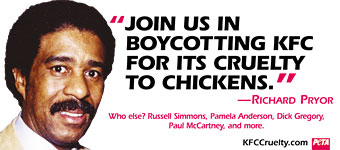
An Open Letter From Sir Paul McCartney to KFC CEO David Novak

July 24, 2003
Dear Mr. Novak:
I am writing on behalf of my friends at People for the Ethical Treatment of Animals (PETA), as well as compassionate consumers across the globe, to urge KFC to implement PETA’s list of eight simple things that need to be done to reduce cruelty to chickens raised and killed for your carry-outs.
For example, I would like to see KFC stop allowing chickens to be bred and drugged so that they become so heavy that they cripple under their own weight, end the starvation of birds who are constantly hungry because they are bred to grow too quickly, stop burning the beaks off parent birds, and make sure slaughter methods do not permit animals to be scalded to death in feather-removal tanks. As you know, full details of PETA’s recommendations are available on KFCCruelty.com.
They are based on the scientific work of KFC’s own animal-welfare advisors and would eliminate only the most horrible abuses of these animals. If KFC suppliers treated dogs or cats the way they treat chickens, they could be charged with the crime of cruelty to animals. I am a vegetarian because I realize that even little chickens suffer pain and fear, experience a range of feelings and
emotions, and are as intelligent as mammals, including dogs, cats, and even some primates. These remarkable animals are deserving of at least a little kindness. Please let PETA know that you will end the most egregious forms of abuse endured by chickens raised and killed for KFC.
Sincerely,
Sir Paul McCartney
**********************************************************
Pink

In between putting out new albums, touring, and even recording the theme song for NBC’s “NFL Kickoff Special,” pop star Pink finds time to stick up for animals. She penned a petition to KFC asking the company to stop allowing its birds to be tortured, which has been signed by tens of thousands of people worldwide. She also put a link to KentuckyFriedCruelty.com on her home page, teaching tens of thousands of her fans about KFC’s cruelty. You can join Pink by signing her petition today.
Pamela Anderson

Former Baywatch babe Pamela Anderson has written to KFC urging the company to improve the lives and deaths of its chickens, appeared in billboards and TV ads asking people to boycott KFC, narrated a video exposé of KFC’s cruelty to chickens, and even asked Kentucky’s governor to remove a bust of Col. Sanders from the State Capitol Building.
Chrissie Hynde
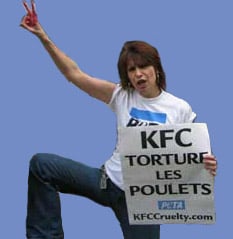
Few faces in the rock world are more recognizable than that of Pretenders frontwoman Chrissie Hynde, a longtime animal rights supporter. In 2004, Hynde took her passion to the streets by smearing “blood” on the windows of a KFC restaurant in France during a lunch-hour protest.
Phil Collins

Phil Collins fought drumsticks with drumsticks by donating his signed drumsticks (the kind you play the drums with, not the kind that come from chickens) to be auctioned off as a benefit for PETA’s “Kentucky Fried Cruelty” campaign.
Emmylou Harris

Motorists from coast to coast have gotten some food for thought from country icon Emmylou Harris, who urges them to boycott KFC in a recent billboard campaign.
……much more celebrities speak out against KFC!!
**********************************************************
Movies:
Watch the Kentucky Fried Cruelty trailers.
The trailers and accompanying descriptions are a fictional dramatization inspired by true events.
Torture Camp
If you ask the Colonel, he'll tell you that the only way to keep a prisoner in line is to see to it that he won't get up when you rub his face in the dirt. And the only way to keep the guards happy is to let them have their fun. That's the way it's always been down on the farm, because that's just how the Colonel likes it.
Crack House
Ever wonder how the Colonel keeps his chickens so strung out? Drugs—that's how. Some say the Colonel likes the feeling of power, but the truth is that he wants chickens to get a real taste for death before he gives it to them. When you ask him about it, he always says the same thing: "There're plenty of ways to get fried."
Fried
When the end comes, it's painful. The Colonel likes to do it the old-fashioned way: "The pop and sizzle, the burning flesh—it's intoxicating," he'll tell ya. It's a rare thing to see the Colonel enjoying himself, but at times like these—when he does the job himself—you might just catch him smiling.
Source: Peta
Subscribe to:
Posts (Atom)
About Me

- Gaia
- Animals' lives are as important to them as ours are to us. We must stand up for them, as good people from other eras stood up to the slave trade.

Stop Puppy Mills



